• You are viewing the forum as a Guest, please login (you can use your Facebook, Twitter, Google or Microsoft account to login) or register using this link: Log in or Sign Up

Still getting a nitrite reading

emmental

New Member
Joined
26 Nov 2025
Messages
18
Location
Northamptonshire
I set up my new tank as follows:
1cm Tropica Plant Growth Substrate
3-6 cm 0.7-1.4mm sand
Seriously boggy bog wood with java fern and anubias from tank that has been running 15 years + assorted attached muck
Additional elderly anubias (with grottier leaves pulled off) and crypts and java ferns from old tank
Lots of little moss balls
More (old, but not used for years) bog wood
Newly purchased plants added:
Taxiphyllum barberi
Sagittaria subulata
Ceratopteris siliquosa
Limnophilla sessiliflora
Ludwigia reopens Rubin
Hygrophila polysperma
I also inadvertently added a few Malaysian Trumpet Snails with the bog wood, sooner than I planned, but they seemed absolutely fine, so I added a few more and they have been partying like its 1999.
No CO2.
I started with a few big water changes in week one, dropping to 2 50% changes a week in weeks 2 and 3, which is where we are now.
I seeded the filter from the older tank last weekend.
I've had a bit of diatom that reduced after the last big water change and now some hair algae on the Saggitaria, though this is growing and spreading.
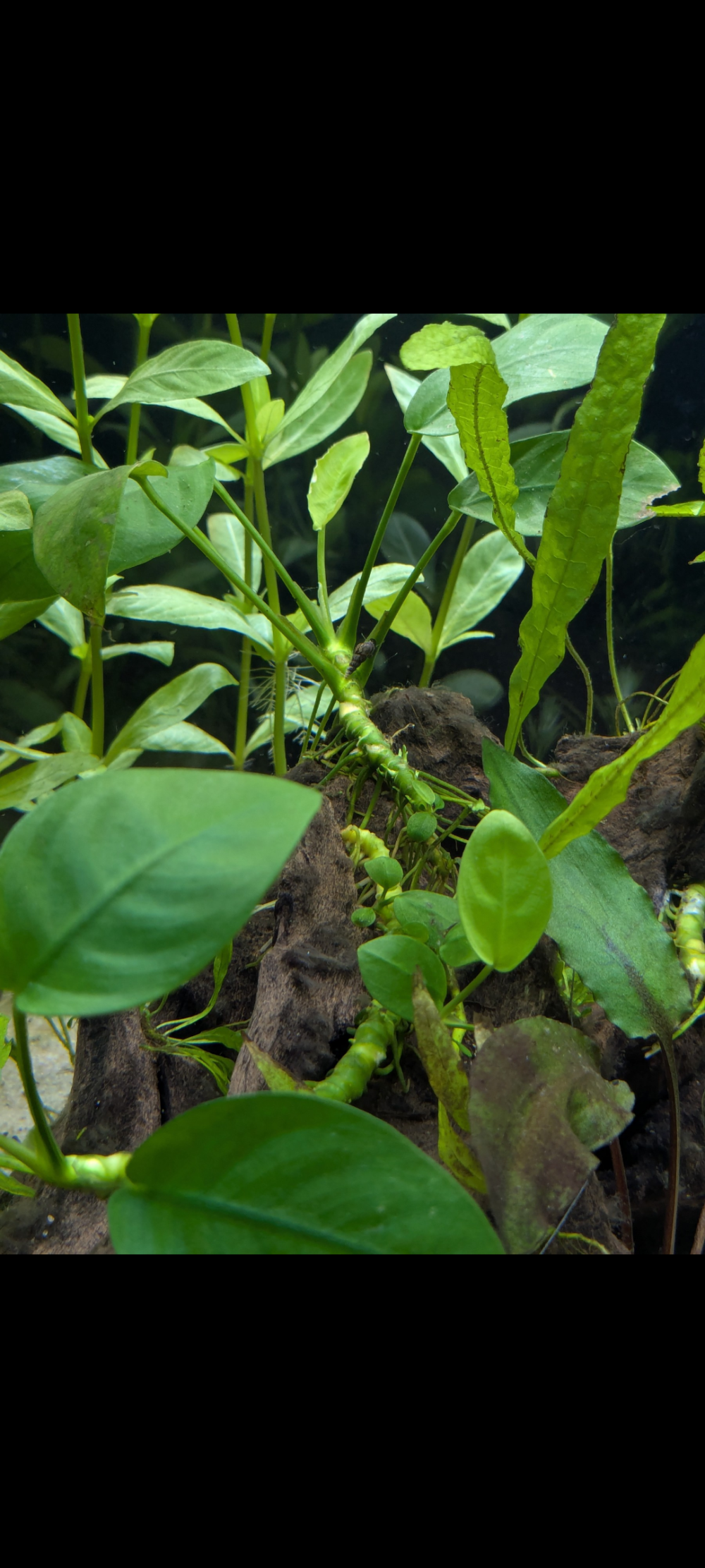
The plants are going crazy. The transferred anubias have produced lots of new leaves, as have the crypts, which have also thrown up some trumpet things.
The Hygrophila has been up to the surface, cut and replanted.
The water sprite is mostly floating and has much more than quadrupled in mass.
Ammonia seems to be zero, but I might order a new kit as mine is a bit old and the liquid is a bit yellow now to start with.
However, nitrites just don't seem to want to go below about 0.15 to 0.2.
I don't know if this is to do with the plant growth substrate, but I'd have thought there was enough sand on top, even at the shallower end to keep this at bay?
I have got about 20 mts in there now, but they aren't digging that deep and seem more concerned with cleaning up some of the older leaves on the crypts that have moved over from the old jungle tank.
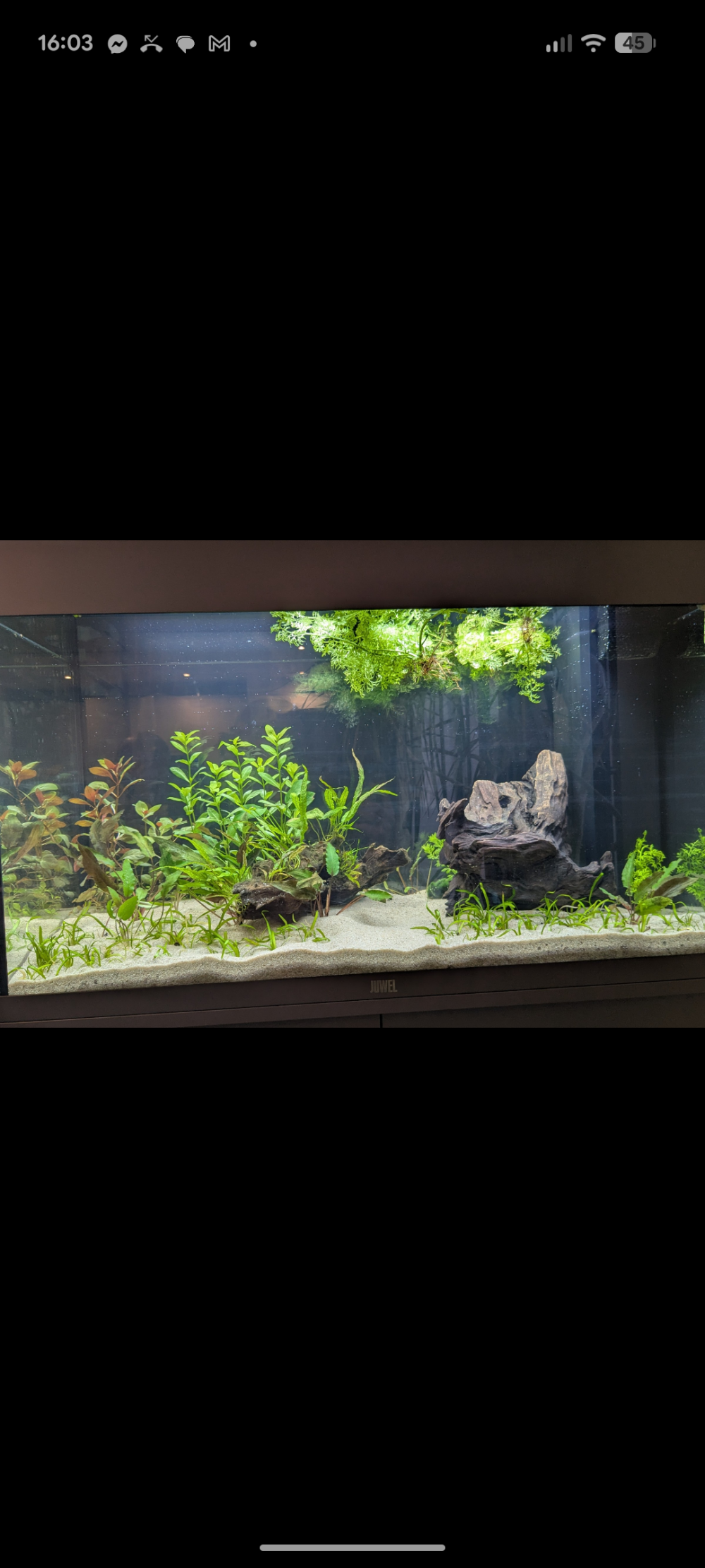
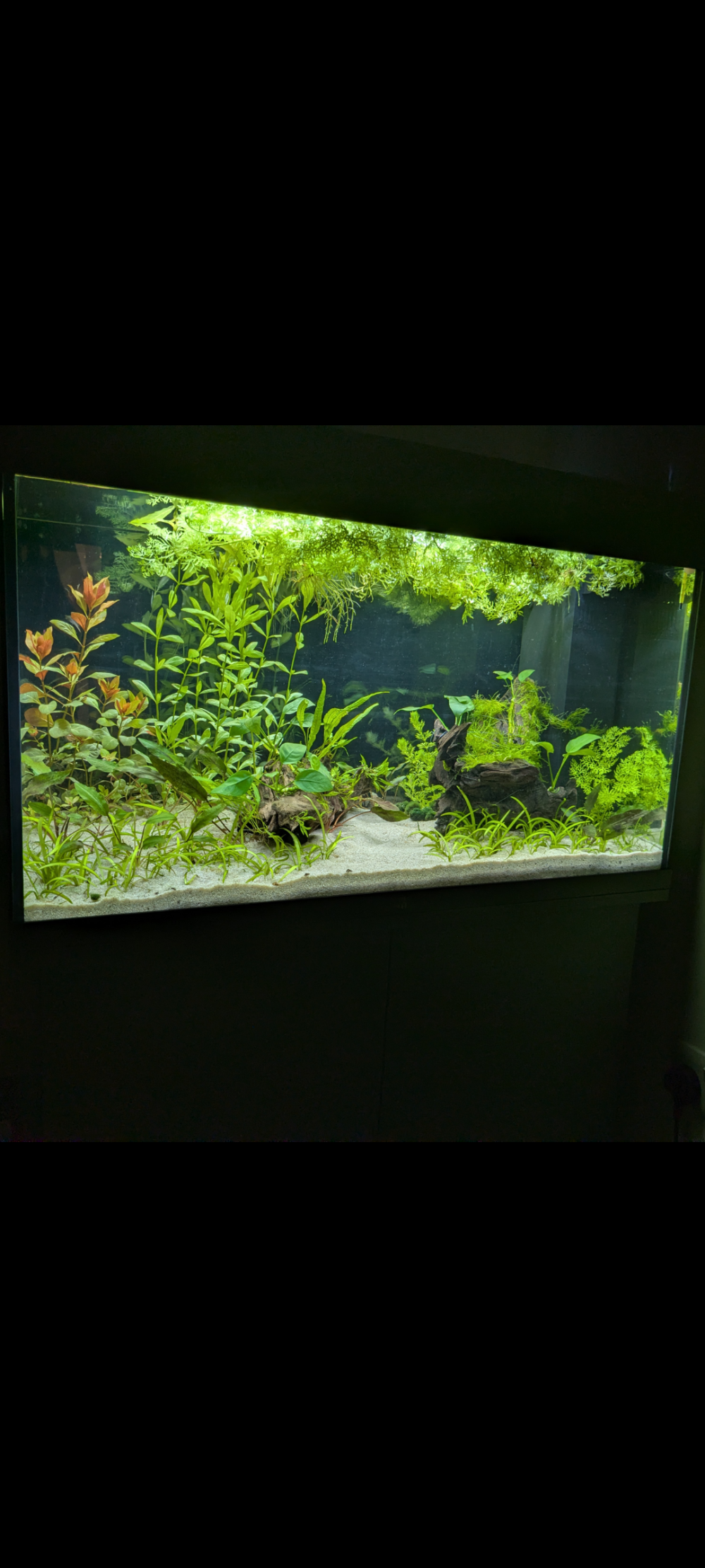
I've attached photos of 2 weeks ago, a few days ago and some of the anubias growth.
 

Attachments

  • Screenshot_20260611-160236.png
    Screenshot_20260611-160236.png
    2 MB · Views: 26
  • Screenshot_20260611-160352.png
    Screenshot_20260611-160352.png
    1.3 MB · Views: 27
  • Screenshot_20260611-160333.png
    Screenshot_20260611-160333.png
    1.7 MB · Views: 25
Do you get a zero nitrite reading from clean water, such as tap water? From what I understood, your tank is 3 weeks old and you have added plants and wood from an old tank, and then also seeded the filter a week ago. I wouldn't expect nitrites at this point with the seeding from the older tank, but it also isn't something that would worry me, as it is not uncommon to have the cycling stage to last a month or so.
 
Out of interest, what are your pH, KH and GH?
Chances are the tank is still 'cycling', and that the plants are consuming the ammonia quite quickly (making it undetectable and fuelling growth), but other bacteria are yet to catch up and establish.
I seeded the filter from the older tank last weekend.
I have done this several times before, and have noted that the cycling is not as 'instant' as one would expect when transfering bacteria laden media over. I haven't quite worked out why this is the case, but transferred mature media does not mean instant readiness.
I don't know if this is to do with the plant growth substrate, but I'd have thought there was enough sand on top, even at the shallower end to keep this at bay?
I think this is fine, and not the cause of your 'problems'.
 
It strongly sounds like the tank is still cycling. They can vary at how long the process takes. From your description it sounds like you are nearly there. Give it another week or so and I strongly suspect the nitrite will been down to zero.
 
I'd been reading on here that once plants were growing well, tank parameters were likely good. I think some people suggested that they used this as an indicator rather than testing. I assume, possibly wrongly, that part of this thinking was that any residual ammonia or nitrite would be being used by the plants and therefore make the tank safe for light stocking. However, having seen the nitrites still hovering there at a low level, I'm not going to do that and I'll wait for a more usual longer period of time and until they drop.
I'm just trying to learn more about it all really.
 
residual ammonia or nitrite would be being used by the plants
I too am surprised. Personally I would use duckweed (with a suitable warning of future bother) or hornwort in a new tank, they are extraordinarily effective at reducing unwanted water nutrients though Nitrite is not the first choice of plants. However, your tank looks lovely and good stem plants will do the job, they just take a little longer. I seed a new aquarium with filter mulm from a mature filter which definitely accelerates the process. You might consider sprinkling a little soil from the roots of a well established houseplant (on which of course no insecticide has been used) into your filter chamber, old soil from plant roots is full of accelerating bacteria, much more effective than anything in a purchased bottle. But I suspect you will have a zero reading in a few days or a week if you simply wait.

Are you softening your tap water? Your plants have grown really well given you have not injected CO2 and you are in a hard tap water zone. I would test the pH, it is the only thing other than TDS that I test regularly. We normally want a slightly acidic pH for plants, certainly at the start of the photoperiod, and as you may know, Nitrite is increasingly toxic in acidic conditions. Frustratingly Ammonia is more toxic with a higher pH.

You will be fine with time however. I've always found Juwel tanks come with balanced equipment, the lights, filter and tank size are well matched. Your substrate will not of itself generate much CO2, so longer term, you may need to think of strategies to introduce CO2 via yeast&sugar or cylinder or even, by including a long-term carbon source into the substrate, though with the latter I suspect you'll not get to 10ppm of CO2 in the water column.

Hope that reassures, is helpful and more importantly encouraging, I am genuinely impressed by your latest photo of plant growth. Keep us up to date and I look forward to seeing a whole tank shot in a month of so with your fish choice.
 
Last edited:
Hi all,
I'd been reading on here that once plants were growing well, tank parameters were likely good. I think some people suggested that they used this as an indicator rather than testing.
I don't test, but nitrite (NO2-) is the easiest form of fixed nitrogen to test for - <"RODI & water storage tanks">. I like a long ~6 weeks growing in period, just to ensure microbial stability. With the impressive plant growth you have I wouldn't be worried about water parameters.

Because the MTS (Melanoides tuberculata) are surviving I think conditions aren't too toxic
. I assume, possibly wrongly, that part of this thinking was that any residual ammonia or nitrite would be being used by the plants and therefore make the tank safe for light stocking.
Plants will make use of all forms of fixed nitrogen. It is a little bit strange that you are getting a nitrite reading, mainly because scientific research has shown that comammox Nitrospira, which oxidise ammonia (TAN NH3 / NH4+) directly to nitrate (NO3-), are the main nitrifying microbes in planted aquariums.Have a look at the links in:
However, having seen the nitrites still hovering there at a low level, I'm not going to do that and I'll wait for a more usual longer period of time and until they drop. It
I'm just trying to learn more about it all really.
That would be my suggestion as well. If it is a genuine nitrite reading? Time should help, and if it isn't? You haven't lost anything, but you have gained some extra stability.

Cheers Darrel
 
Last edited:
My tank is covered, so I understand that I'm limited in what I can have in the way of floating plants that can cope with the humidity, hence the water sprite, but happy for other suggestions for plants that would manage.
pH is about 8, 8.5 by late afternoon.
We have an inline water softener thing where the mains comes in. I've asked about it on another thread. It doesn't affect the actual composition of the water, I think it's a temporary effect to prevent scale build up.
 
inline water softener thing
The magnet/electrical coil devices supposedly just keep things in suspension to protect the hot pipes once the water exits, it behaves as normal and scales up my shower heads. I use rain water to mix with my tap water when doing a water change and top-up with Brita filter water, with a good cover I found the Juwel set up was low in evaporation so reducing the hardness a bit with soft water was easy to sustain. I regret not buying a Juwel set-up when we moved into this house.
Indian fern will work well, more or less the only floating plant in my main tank.
I'm surprised that you are having such success with a pH of 8-8.5, but then I'm surprised you are having a trace Nitrite reading, live and learn. Best regards.
 
Hi all,
I'm surprised that you are having such success with a pH of 8-8.5, but then I'm surprised you are having a trace Nitrite reading, live and learn. Best regards.
I think the pH just reflects the CO2 level, as it is used more quickly than it is replaced. My understanding is that pH changes due to Dissolved Inorganic Carbon (DIC) are slightly different, you need @Andy Pierce for the chemistry -< "A question, dissolved oxygen and a pond">.

Cheers Darrel
 
I think the pH just reflects the CO2 level, as it is used more quickly than it is replaced. My understanding is that pH changes due to Dissolved Inorganic Carbon (DIC) are slightly different, you need @Andy Pierce for the chemistry -< "A question, dissolved oxygen and a pond">.
Not totally clear what the question is...

You're using tap water right? In Northamptonshire the water will have KH between 200 to 250 ppm, so not as alkaline as Cambridgeshire water which ranges from 250 ppm to 300 ppm but still pretty alkaline. You're not injecting CO2 (which would lower the pH) so under usual conditions absent 'active substrate' (looks like you have silica sand) the pH would be around 8.5 give or take, which is what you observe. The inline water softener (you don't put salt in it right?) won't change your pH (or the mineral hardness either actually) in the tank. Your tank is not very heavily planted and even if it were, plant growth will be CO2 limited in this non-injected setup so the plant consumption of CO2 during the day is going to be very modest. No big animals to put CO2 into the water through respiration either so I'd expect pH to be pretty stable. The one difference is after a water change your pressurised tap water will carry dissolved CO2 in it that will temporarily depress the pH until it equilibrates in the non-pressurised setup.

I'm glad the Hygrophila polysperma is working for you - it's a true weed to be sure. Otherwise long term I (and others) have found it challenging to grow plants in CO2-not-injected high pH water, but give it a go and see how you do.

My tank is covered, so I understand that I'm limited in what I can have in the way of floating plants that can cope with the humidity, hence the water sprite, but happy for other suggestions for plants that would manage.
I think you have this backwards actually. The main problem floating or emersed plants have is lack of humidity, not too much humidity. Having your tank covered will keep the humidity under the cover high so you'll have lots of options even for emersed plants. Floating plants I have found really don't care - the local humidity is generally high enough even with an uncovered tank - your covered tank should be able to grow whatever type of floating plant you want. Your water sprite looks great but feel free to have a try with whatever else strikes your fancy. I like Salvinia minima for example, but lots of great choices.

As others have said 3 weeks in is really early days. Your tank might still be cycling, but actually, without any animals in there there isn't much to be cycled - usually it's ammonia/ammonium from excretion you'd worry about and that's not a problem you have. It's possible your nitrate test isn't working - what does it say if you just test your tap water?
 
Thank you for your reply, that's really useful and good to know.
The test kit is quite old and I'm planning on getting another, but having said that, it's showing zero ammonia, nitrite and nitrate for my long running heavily planted and very lightly stocked bigger tank that I'm winding down. Tap water showed zero nitrite, I can't remember if I tested it for nitrate.
I have just got a yeast based CO2 system to try and see how that goes.
The anubias is really thriving in the new tank, but the lights are much brighter than in the previous tank and they've obviously had a decent amount of nitrate recently with the tank cycling, whereas is had been really low in the old tank.
 
Back
Top